
Special Educational Needs and Disability (SEND) and Inclusion Information
At St Agnes we aim to provide all children with an education according to their individual needs. We believe that the educational goals for all children are the same. All pupils are encouraged to be actively involved in self-assessment and planning. We hope to achieve a positive partnership with parents. The term Special Needs is a very broad one, covering a wide range of conditions. A child may experience difficulties, which may fall into one or more of the following categories:
1. a physical or mental disability
2. a problem relating to hearing, speech or sight
3. a behavioural or emotional problem.
4. difficulties related to a specific curriculum area ie. Mathematics
5. difficulties of a more general nature covering some or all areas of the curriculum

SEND Information Directory
As part of our new Information Directory we have a section on SEND resources and support for parents. Please use the link to visit this page.
For some children these areas of Special Needs become apparent before they come into school and may be highlighted by medical professionals. However in most cases the need for extra help will only become clear after they start school. The school has a policy document in place, which explains the rational, purposes, and guidelines of how each child’s individual needs will be met. This policy conforms to the guidelines laid down by the Local Authority (LA) and is in accordance with the government’s requirements. The policy is available for parents to view on request should the need arise, it is available on the School Website. There is a designated SENCo, Mrs Amy Butterworth, in school whose specific role is to develop, implement and monitor the school’s SEN policy. She is directly accountable to the governors. Mrs Butterworth also has a responsibility to liaise between colleagues, parents, pupils and outside agencies when it is appropriate. The rights of all pupils to have access to a broad, balanced and relevant curriculum is fundamental to the ethos and philosophy of the school. The school will make every attempt to accommodate the needs of every child regarding areas of provision for special needs, currently in school we have a disabled toilet and one ramp. Accessibility for wheelchairs is limited.
SENCo: Mrs A. Butterworth
SEND Governor: Ms S Gittins
Please note: Whilst every effort has been made evaluate these sites for content, St Agnes School is not responsible for the content of external Internet sites.
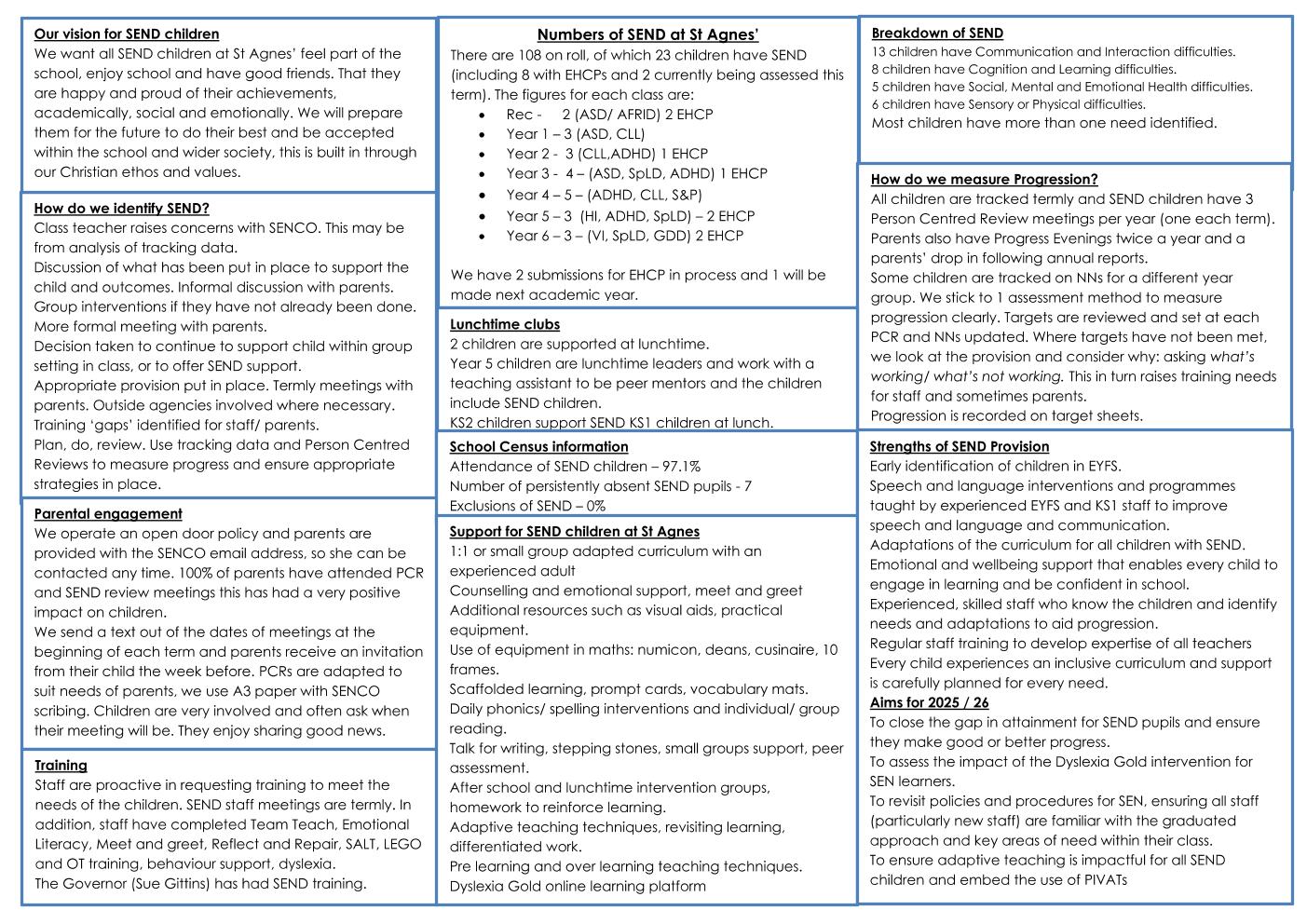
To find out more about our provision at school for children with additional needs please select the appropriate document from below.

SEND at St Agnes Key Concepts 2025-26

|
SEND at St Agnes Key Concepts 2025 | [pdf 159KB] |

|
SEND Continued Professional Development
Continued professional development is an integral part of our school’s success for SEND. This academic year, we have had several SEND training sessions where we staff have enhanced and refreshed our knowledge in topics such as SMART targets, Deploying TAs effectively, Adaptive Teaching, ADHD, ADHD Strategies and SEN Support Plans. In Autumn 2024, we held a session on High Quality Teaching Strategies to support SEND, as well as some training on Dyslexia and Literacy Difficulties due to the increasing requirements of our cohorts in this area.
We continue to uplevel our pedagogical knowledge using the latest research and guidance reports. For SEND at St Agnes, we are using the current guidance from the Education Endowment Fund to ensure that pupils; work in a positive, supportive environment, have a holistic, understanding approach to their need, ensure pupils receive high quality teaching, appropriate interventions, and work effectively to support teaching assistants.


Creating a supportive learning environment for all pupils, without exception
At St Agnes, this involves:
- Promoting positive engagement, active relationships and wellbeing for all pupils.
- Ensure that all pupils can access the best possible teaching.
- Adopt a positive approach to behaviour.

Building an ongoing holistic understanding of our pupils and their needs
At St Agnes, this involves:
- Using a graduated approach of Plan. Do. Review.
- Assessment that is regular and purposeful.
- Guidance from parents/carers, as well as specialist professionals.
- Teachers who are empowered and trusted to make informed choices about a pupil’s next steps for learning.

Ensuring that all pupils have access to high quality teaching
At St Agnes, this involves:
- Ensuring that good teaching for SEND is good teaching for all.
- Using flexible groupings.
- Explicit instruction.
- Using technology to support pupils with SEND.
- Scaffolding learning.
'Five a Day' Approach
We also use the ‘5 a day’ approach across school to support high quality teaching to improve outcomes for pupils with SEND. At St Agnes this involves:


Complement high quality teaching with carefully selected small-group and one-to-one interventions
At St Agnes, this involves:
- Delivering appropriate, measured, and planned interventions where the impact is appropriately measured.
- Ensuring that interventions are delivered intensively and in a structured manner that are carefully targeted though identification and assessment of need.

Work effectively with teaching assistants
At St Agnes, this involves:
- Effective deployment of teaching assistants.
- Ensuring that TAs have a positive impact on the lives of all pupils.
- TAs to supplement the teaching from the class teacher.
- We use the advice from EEF’s Making Best Use of Teaching Assistants guidance to continually develop this https://educationendowmentfoundation.org.uk/education-evidence/guidance-reports/teaching-assistants
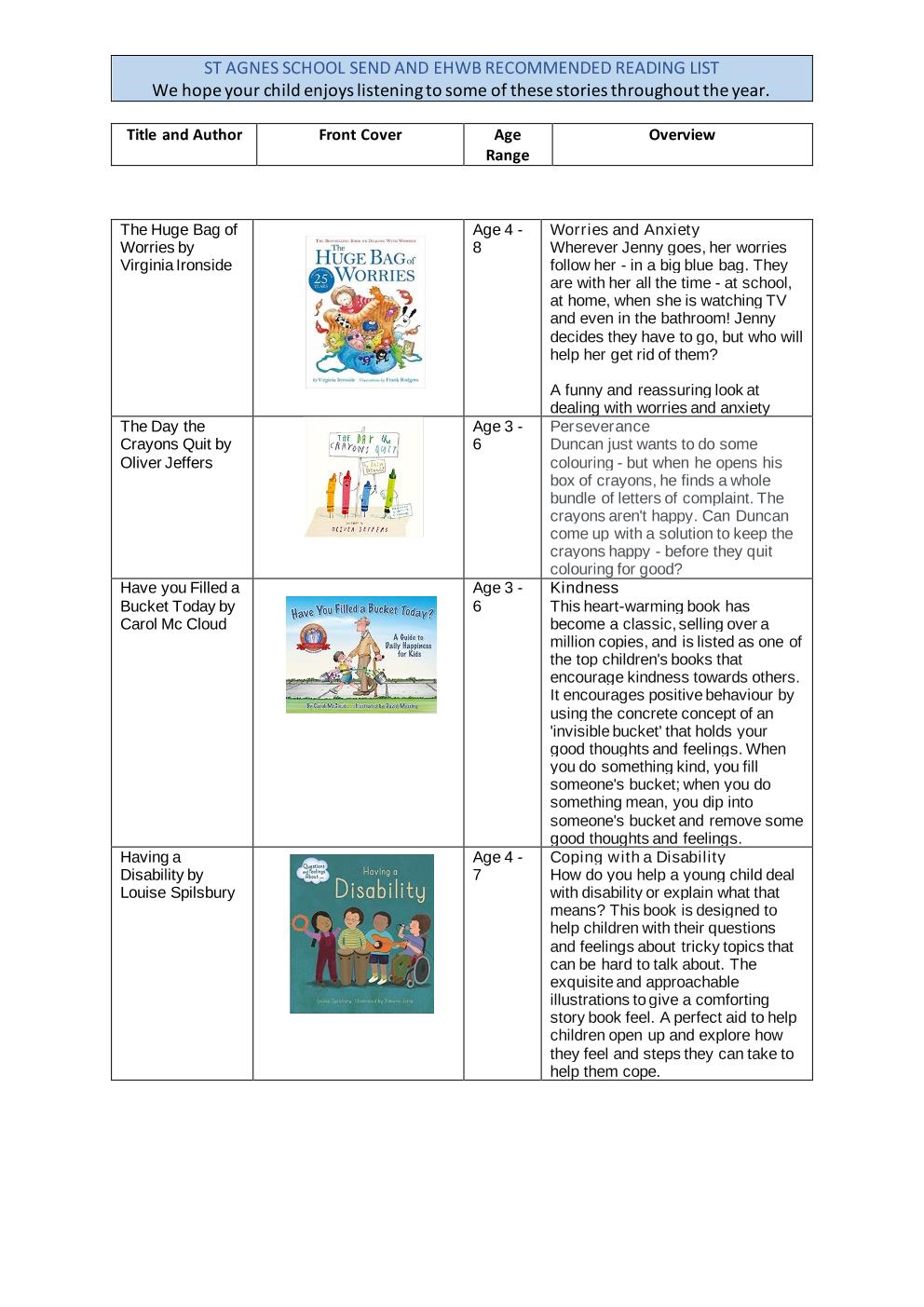
SEND and Inclusion Recommended Reading List
Please take a look at the reading list which recommends a number of award winning books which cover a number of SEND and Inclusion subjects.
|
|
ST AGNES SEND and EHWB RECOMMENDED READING LIST | [pdf 598KB] |
|

Metacognition and Self-regulated Learning
Evidence suggests the use of metacognitive strategies which get pupils to think about their own learning can be worth the equivalent of an additional +7 months progress when used well. This guidance report reviews the best available research to offer teachers and senior leaders practical advice on how to develop their pupils’ metacognitive skills and knowledge. We have used the findings of this report to inform the development of our Curriculum. Please use the link to find out more.

Special Educational Needs in Mainstream Schools
Pupils with Special Educational Needs and Disability (SEND) have the greatest need for excellent teaching and are entitled to provision that supports achievement at, and enjoyment of, school. The attainment gap between pupils with SEND and their peers is twice as big as the gap between pupils eligible for free school meals and their peers. However, pupils with SEND are also more than twice as likely to be eligible for free school meals.
This guidance report offers five evidence-based recommendations to support pupils with SEND, providing a starting point for schools to review their current approach and practical ideas they can implement. We have used the findings of this report to inform the development of our SEND provision. Please use the link to find out more.

Oldham SEND Local Offer (OSLO)
OSLO is Oldham’s SEND Local Offer and is for children and young people with Special Educational Needs and Disabilities (SEND) aged 0 to 25 years, their parent carers and the practitioners who work with them.
To access the Oldham Local Offer please click on the link.

|
SEND Local Offer Video | [mp4 20MB] |
|

Oldham Council SEND Written Statement
These website pages contain information about Reports, strategies, values, codes of practice (SEND).
To access the Oldham Council SEND Written Statement please click on the picture link.
Children's Additional Needs and Disability Register

Please can we encourage our parents to add their details to the register so that they can receive updates and alerts when new services and resources are added to the Local Offer Directory.
Please click on the picture link to register on their website.

Parents of Oldham in Touch - P.O.I.N.T.
P.O.I.N.T. website is packed with information to support you and your child or young person. We are determined that through our collaborations across Health, Education and Social Care, that together, we can improve the life chances and aspirations of children and young people with additional Needs and disabilities.
To find out more visit their website by clicking on the picture link or select the document below to download their handbook.
POINT Co-production

Government Advice - Making a Complaint about Special Educational Needs Provision (SEN)
If you want to complain about a school’s SEN support, you should do it while your child is still registered at the school. This includes complaints that the school has not provided the support required by your child’s SEN statement or education, health and care (EHC) plan.
Please access the government's advice website by clicking on the picture link or to view our school Complaints Policy please use this link.